

Quadband 2G, 3G, 4G DCS, 4G LTE Mobile Network Signal Booster 900/1800/2100/2600mhz Cellular Signal Amplifier Mobile Repeater

KSh 13,000.00 (EX.Vat)
Key Features
A Quad-Band Mobile Network Signal Booster enhances cellular signal strength across 2G, 3G, and 4G networks by amplifying frequencies at 900 MHz, 1800 MHz, 2100 MHz, and 2600 MHz. Key features include:
-
Multi-Band Support: Simultaneously amplifies signals across 900 MHz (GSM), 1800 MHz (DCS), 2100 MHz (WCDMA), and 2600 MHz (LTE) frequency bands, ensuring compatibility with various network providers and technologies.
-
Enhanced Coverage: Extends signal coverage, effectively eliminating dead zones and providing reliable connectivity in areas with weak reception.
-
High Gain Amplification: Features high gain levels, boosting weak signals to ensure clear voice calls and stable data connections.
-
Automatic Gain Control (AGC): Incorporates AGC technology to automatically adjust signal amplification, preventing interference and maintaining optimal performance.
-
Full-Duplex Communication: Supports simultaneous transmission and reception of signals, facilitating seamless two-way communication.
-
User-Friendly Installation: Designed for easy setup with clear instructions, allowing users to quickly enhance their mobile signal without professional assistance.
-
LED Indicators: Equipped with LED indicators to display operational status and signal strength, aiding in optimal positioning and troubleshooting.
These features collectively ensure that a Quad-Band Mobile Network Signal Booster provides reliable and enhanced mobile connectivity across various network technologies.
Quadband 2G, 3G, 4G DCS, 4G LTE Mobile Network Signal Booster
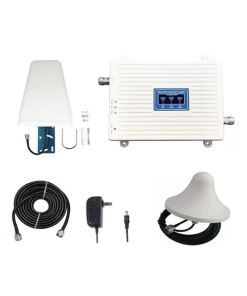
Quadband Signal Booster is designed to improve cellular coverage by receiving an available outdoor mobile signal, amplifying it and redistributing the enhanced signal indoors.
This 2G 3G 4G signal booster Kenya solution supports four commonly used cellular frequency bands: 900MHz, 1800MHz, 2100MHz and 2600MHz. It is suitable for improving mobile communication and data coverage in homes, offices, shops, warehouses, hotels and other areas where indoor cellular reception is weak.
If you are looking for a 4G signal booster Kenya, GSM signal booster Kenya, or mobile network signal booster Kenya, this quadband system provides broader frequency coverage than a conventional single-band booster.
How Does a Mobile Signal Booster Work?
A mobile network signal booster consists primarily of an outdoor antenna, signal amplifier and indoor antenna. The outdoor antenna captures an existing cellular signal from a nearby mobile network tower. The amplifier strengthens the signal before the indoor antenna distributes the improved coverage within the required area.
A booster does not create a mobile signal where there is absolutely no signal. It works best where there is already a usable outdoor signal that can be captured and amplified.
Do mobile phone signal boosters really work?
Yes. A properly installed cellular signal booster can significantly improve indoor mobile reception when there is an existing outdoor signal to amplify. Performance depends on factors such as the strength of the outdoor signal, distance from the network tower, building construction, antenna positioning and the frequency bands supported by the booster.
For the best results, the outdoor antenna should be positioned where it can receive the strongest available cellular signal.
How Can I Make My 4G Signal Stronger?
If you have weak indoor 4G reception, a 4G LTE signal booster Kenya can help improve coverage where an adequate outdoor signal is available.
Other factors that can affect 4G performance include:
- Your distance from the nearest mobile network tower
- Building walls and construction materials
- Your location and surrounding terrain
- Network congestion
- The frequency bands supported by your mobile network
- Positioning of your phone or router
- Quality and installation of the external antenna
A 900/1800/2100/2600 MHz signal booster provides multi-band coverage, making it a versatile option for locations where different cellular services operate across multiple frequencies.
Quadband vs Triband Signal Booster
| Feature | Quadband Signal Booster | Triband Signal Booster |
| Number of frequency bands | 4 bands | 3 bands |
| Typical frequencies | 900 / 1800 / 2100 / 2600MHz | Depends on model |
| 2G support | Yes, where applicable | Yes, where applicable |
| 3G support | Yes, where applicable | Yes, where applicable |
| 4G LTE support | Yes, on supported bands | Yes, on supported bands |
| Coverage flexibility | Higher | Moderate |
| Recommended for | Homes, offices, shops and larger installations requiring multiple bands | Locations requiring three specific bands |
Why choose Quadband? A quadband booster provides greater frequency flexibility because it supports four bands instead of three. However, the best choice should always be based on the frequencies available from the mobile networks at your location.
Key Features
- Quadband 2G/3G/4G LTE support
- Supports 900MHz, 1800MHz, 2100MHz and 2600MHz
- Designed for improving weak indoor cellular coverage
- Supports voice calls and mobile data on compatible bands
- Suitable for homes, offices, shops and commercial premises
- External and internal antenna configuration
- Helps reduce dropped calls caused by weak indoor reception
- Improves cellular coverage in signal-shadow areas
- Suitable for multi-band cellular environments
- Professional installation can optimize performance
Applications
The mobile network booster for home Kenya is suitable for a variety of environments where indoor cellular reception is weak.
- Homes and Apartments
Improve mobile coverage in rooms where walls, floors or building materials interfere with cellular reception.
- Offices
A GSM signal booster for office applications can help provide better indoor connectivity for calls and mobile data where cellular reception is poor.
- Shops and Businesses
Useful for retail shops, small businesses and commercial premises located in areas with weak indoor mobile coverage.
- Warehouses
Large warehouses can experience weak cellular reception because of metal structures and enclosed spaces. A properly designed booster installation can help improve coverage.
- Hotels and Guest Houses
Improve cellular availability in guest rooms, reception areas and other indoor spaces where mobile coverage is inconsistent.
- Rural and Remote Locations
A booster can be useful where an outdoor mobile signal is available but indoor reception is weak. The external antenna needs to be positioned appropriately to capture the available signal.
Why Buy Your GSM Signal Booster from IT Accessories?
When searching for a signal booster price in Kenya, it is important to consider more than just the initial purchase price. The frequency compatibility, installation requirements, antenna quality and intended coverage area can all affect the final performance of the system.
IT Accessories provides cellular signal booster solutions for customers looking to improve mobile coverage in homes, offices and commercial premises.
We can help you select a suitable GSM signal booster Kenya solution based on your required frequency bands and application.
Buy with Confidence
- Professional product guidance
- Suitable solutions for homes and businesses
- Multi-band cellular signal booster options
- Assistance with selecting the appropriate system
- Kenya-based supplier
- Convenient Nairobi location
- Contact us for product availability and current GSM signal booster price in Kenya
Who Should Buy a Quadband Signal Booster?
This product is particularly suitable for customers experiencing:
- Weak indoor mobile signal
- Dropped calls
- Poor voice-call quality
- Slow 4G mobile data
- Unstable cellular connectivity
- Poor signal inside offices or buildings
- Weak coverage caused by thick walls or metal structures
- Inconsistent mobile reception in rural or semi-rural areas
If you need a 2G 3G 4G 5G signal booster Kenya solution capable of supporting multiple frequency bands, the quadband configuration is worth considering.
Frequently Asked Questions
What is a Quadband signal booster?
A quadband signal booster is a cellular signal amplifier designed to support four different frequency bands. This model supports 900MHz, 1800MHz, 2100MHz and 2600MHz, subject to the specific network frequencies available in your area.
Do mobile phone signal boosters really work?
Yes. They can improve indoor cellular reception when there is an existing outdoor signal that can be captured by the external antenna. They cannot generate a mobile signal in an area where there is no usable signal at all.
How can I make my 4G signal stronger?
A 4G LTE signal booster Kenya can improve indoor 4G reception where an adequate outdoor signal exists. Proper external antenna positioning is important for achieving good results.
What is the best signal booster for a cell phone?
The best signal booster depends on the frequency bands used in your area, the size of the building and the strength of the available outdoor signal. A quadband model can be advantageous where you need support for 900/1800/2100/2600MHz frequencies.
What is the difference between a GSM booster and a 4G LTE booster?
A GSM booster generally refers to equipment supporting GSM cellular frequencies, commonly associated with 2G voice services. A 4G LTE booster is designed to amplify compatible LTE frequencies. A quadband system can support multiple technologies depending on the bands and network services available.
Can this booster be used at home?
Yes. It can be used as a mobile network booster for home Kenya applications where indoor cellular reception is weak and an adequate outdoor signal is available.
Can the booster improve mobile internet?
Yes, where the supported 4G LTE frequency is available and there is sufficient outdoor signal to amplify. The actual internet speed will still depend on the mobile network, tower capacity, signal quality and network congestion.
Which frequencies does this signal booster support?
The system supports 900MHz, 1800MHz, 2100MHz and 2600MHz, making it a four-band cellular signal amplifier.
What affects signal booster performance?
Performance can be affected by outdoor signal strength, antenna placement, cable length, building construction, distance between the outdoor and indoor antennas, network frequency and the size/layout of the building.
Do I need professional installation?
Professional installation is recommended, particularly for larger buildings or commercial applications. Correct positioning of the outdoor and indoor antennas is important for maximizing performance and preventing unwanted interference.
Buy Quadband Signal Booster in Kenya
Looking for a reliable Quadband signal booster Kenya, 4G signal booster Kenya, or GSM signal booster Kenya?
Buy from IT Accessories and get assistance in selecting a suitable mobile network signal amplification solution for your home, office or business.
IT Accessories
Town House Building, along Kaunda Street, 6th Floor, Room 606, Nairobi, Kenya
sales@itaccessories.co.ke
+254 780 303 054
Be the first to review “Quadband 2G, 3G, 4G DCS, 4G LTE Mobile Network Signal Booster 900/1800/2100/2600mhz Cellular Signal Amplifier Mobile Repeater”
Related products

Reviews
There are no reviews yet.